


Magnetic Particle Testing (MPT), also known as Magnetic Particle Inspection (MPI), is a widely used non-destructive testing method for finding surface and near-surface discontinuities in ferromagnetic materials, including carbon steels, cast irons and low-alloy steels.
At AME, we use MPT/MPI to pinpoint cracking, laps, seams, porosity and weld defects in assets that operate under demanding mechanical or environmental conditions. As a NATA-accredited inspection provider, AME ensures all Magnetic Particle Testing is performed in accordance with recognised Australian and international standards, giving clients confidence in the reliability and traceability of results.
Our technicians carry out reliable inspections across mining, oil and gas, manufacturing, marine, transport and structural fabrication sectors.
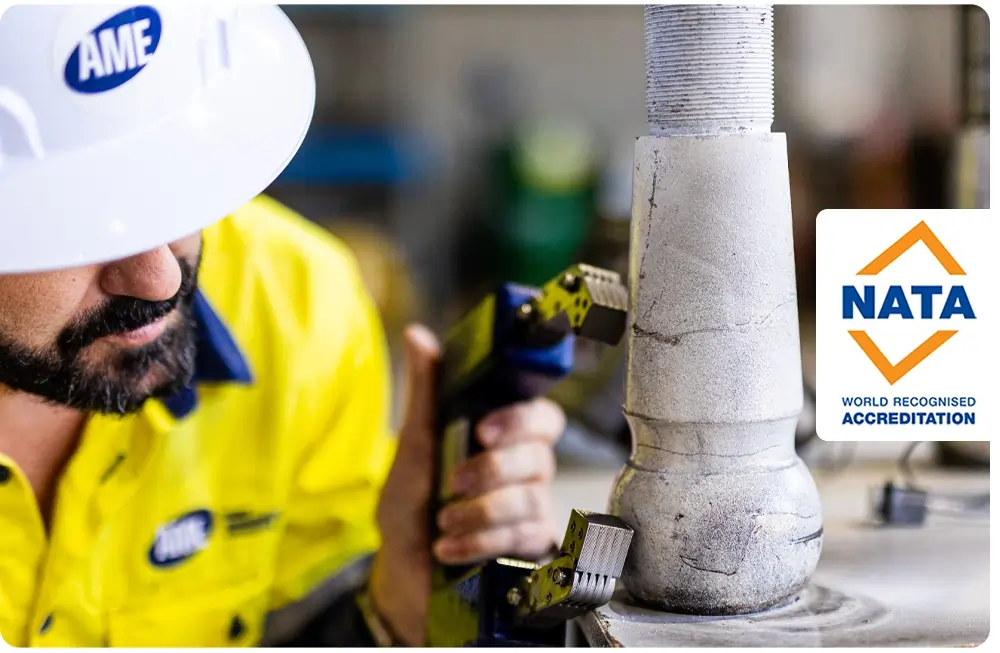
What Is Magnetic Particle Testing?
Magnetic Particle Testing works by magnetising a component to create a magnetic field within the material. When a flaw disrupts this field, it produces leakage lines at the surface. Finely milled magnetic particles — either dry powder or a wet fluorescent suspension — are then applied. The particles gather at these leakage points, forming sharp, visible indications of any discontinuity.
This method is extremely effective for detecting:
- Fatigue cracking
- Weld toe and weld root defects
- Grinding cracks
- Shrinkage cracks in castings
- Discontinuities in machined components
- Heat-affected zone cracking
Because MPT reveals flaws that may be invisible to the naked eye, it is ideal for in-service inspection, failure analysis, and routine preventative maintenance.
Applications
Magnetic Particle Testing is suitable for any ferromagnetic material and is used extensively across:
- Structural and pressure welds
- Mining equipment (pins, bores, dragline components)
- Lifting equipment, hooks, shackles and rigging gear
- Shafts, gears, axles and rotating equipment
- Pipelines, vessels and fabricated steel structures
- Marine components and winching systems
- Castings and machined parts
Early detection of cracking helps operators prevent catastrophic failures, maintain compliance with safety regulations and extend asset life.
MPT Methods We Use
AME technicians are qualified to apply a range of Magnetic Particle Testing techniques to suit different environments, access conditions and asset types.
Yoke Method
A portable electromagnet is placed on the surface, creating a localised magnetic field. This is ideal for welds, structural connections and areas with limited access.
Wet Fluorescent MPI
A high-sensitivity method using fluorescent particles viewed under UV light. Excellent for fine crack detection and complex geometries.
Dry Powder MPI
Ideal for rougher surfaces or outdoor use where visibility and portability matter.
Equipment and Setup
AME uses modern, calibrated electromagnets, power packs, UV lamps and magnetic particle media to ensure clear, stable test indications. Proper surface cleaning, magnetisation technique and demagnetisation after testing are essential steps our technicians perform to keep results consistent and reliable.
AME Magnetic Particle Testing Process
Our MPT/MPI process follows the same structured, quality-controlled approach applied across all AME NDT services:
We assess specified codes and acceptance criteria as well as supplied weld procedures, drawings, and any prior NDT reports to the inspection scope.
Coatings, rust or debris are removed to ensure the magnetic particles can cluster accurately around any discontinuities.
The appropriate technique is chosen based on geometry and accessibility.
Dry or wet particles are applied while the component is magnetised. Any leakage fields create clear indications of flaws.
Our certified technicians assess particle build-up to determine if a crack or discontinuities are present and classify the severity in line with relevant standards.
The item is demagnetised where required and cleaned to restore it to service-ready condition.
A detailed report is provided, including photographs, indication locations, defect descriptions and any recommended corrective actions.
Benefits of Magnetic Particle Testing
- Highly sensitive to fine surface and near-surface cracks
- Immediate, on-site results for faster decision-making
- Works well on welds, castings and machined surfaces
- Portable options for field or workshop inspections
- Effective for complex geometries and irregular shapes
- Quick setup and minimal surface preparation compared to other methods
Limitations
MPT/MPI is only suitable for ferromagnetic materials, and heavily coated or dirty surfaces may require cleaning before inspection. Proper magnetisation direction and experienced interpretation are essential to avoid false indications.
Australian Standards
All AME Magnetic Particle Testing is carried out under our NATA-accredited quality system and in accordance with the following standards:
| Document Number | Reference Title / Scope |
|---|---|
| AS ISO/IEC 17025 | General requirements for the competence of testing and calibration laboratories |
| AS ISO 9712 | Non-Destructive Testing – Qualification and certification of personnel |
| AS 1171-1998 | Non-destructive testing – Magnetic particle testing of ferromagnetic products, components and structures |
| ISO 9934-1:2016 | Non-destructive testing – Magnetic particle testing – Part 1: General principles |
| AS ISO 9934.2:2020 | Non-Destructive testing – Magnetic particle testing – Part 2: Detection media |
| ISO 9934-3 | Non-destructive testing – Magnetic particle testing – Part 3: Equipment |
| ISO 17638:2016 | Non-destructive testing of welds – Magnetic particle testing |
| ISO 23278:2015 | Non-destructive testing of welds – Magnetic particle testing – Acceptance levels |
| ISO 3059 | Non-destructive testing – Penetrant testing and magnetic particle testing – Viewing conditions |
| ISO 10893-5 | Non-destructive testing of steel tubes – Magnetic particle inspection of seamless and welded ferromagnetic steel tubes |
| ISO 4986:2020 | Steel and iron castings – Magnetic particle testing |
| ASTM E1444 / E1444M | Standard Practice for Magnetic Particle Testing |
| ASTM E709 | Standard Guide for Magnetic Particle Testing |
| ASTM A275 / A275M | Standard Practice for Magnetic Particle Examination of Steel Forgings |
| ASTM A456 / A456M | Specification for Magnetic Particle Examination of Large Crankshaft Forgings |
| OEM Procedures | According to asset type, client requirements, and required NDT scope |
Compliance ensures consistent, defensible results for safety-critical components.
Why Choose AME
- Certified ISO 9712 Level II technicians.
- NATA-accredited procedures ensuring traceable, reliable results.
- Modern MPT/MPI equipment including UV systems and calibrated electromagnets.
- Proven expertise across heavy industry, mining, infrastructure and marine.
- Detailed reporting with photographic evidence and clear recommendations.
- Ability to combine MPT with UT, PT, VT or engineering assessments for a full integrity package.
Other NDT Services We Offer
In addition to magnetic particle testing, AME delivers a full suite of supporting non-destructive testing (NDT) services, giving clients a practical way to confirm the condition, integrity and ongoing performance of critical assets.
Our NDT capabilities include:
Ultrasonic Testing (UT) is a non-destructive inspection method that uses high-frequency sound waves to detect internal flaws, measure material thickness, and assess subsurface discontinuities in a wide range of components and structures.
➜ Learn more about AME’s Ultrasonic Testing Services
Dye Penetrant Testing (PT) is a surface inspection technique used to reveal open-to-surface defects such as cracks and porosity in non-magnetic materials, including stainless steel and aluminium components.
Eddy Current Testing (ET) uses electromagnetic induction to identify surface and near-surface discontinuities, assess coating thickness, and evaluate material properties in non-ferrous metals.
➜ Learn more about AME’s Eddy Current Testing Services
As the most basic non-destructive testing method, visual inspection focuses on close examination of surfaces using appropriate lighting, magnification, and imaging tools to identify visible defects and confirm surface condition.
AME’s qualified technicians are trained to apply the most appropriate inspection method for each situation. Whether you need a single method or a combined testing program, we deliver accurate, standards-compliant results to support maintenance, certification, and asset life management.
Book an Ultrasonic Testing Service
If you need reliable Magnetic Particle Testing for your machinery, infrastructure or critical components, AME can help.
Contact our team to arrange an inspection or request a quote. We’ll ensure your assets are evaluated safely, efficiently and in full compliance with Australian Standards.
Contact AME Perth on (08) 9466 7444 or email info@asseteng.com.au or Kalgoorlie on (08) 9091 3553 or email to kalgoorlie@asseteng.com.au for further details.