


What is Eddy Current Testing?
Eddy Current Testing (ECT) is one of the most effective and efficient methods amongst many NDT testing techniques. It uses electromagnetic induction to identify and analyse surface and sub-surface flaws in conductive materials.
Changes in the eddy current are interpreted by the testing equipment to identify surface cracking and surface planar discontinuities, mainly in ferritic materials (weld materials, heat-affected zones and parent materials).
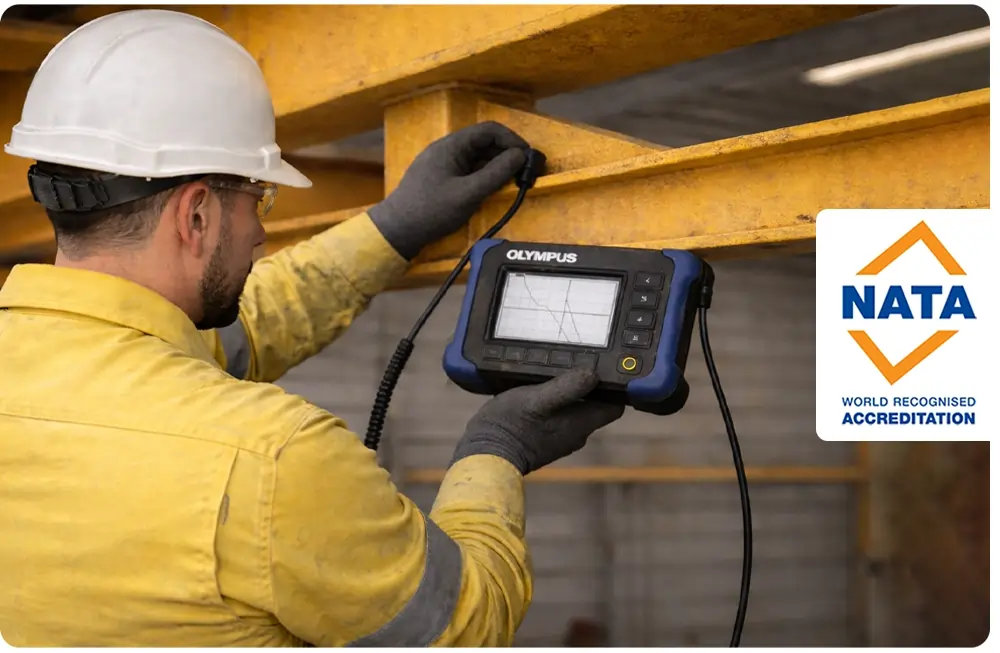
Eddy Current Testing offers a perfectly reliable and economical inspection technique, which is faster and more cost effective than other NDT services available. In most cases, it is not required to remove the paint, unlike Mag Particle Testing (MPT).
Applications and Use of Eddy Current Testing (ECT)
The Eddy Current Testing technique can be applied to coated and uncoated objects during fabrication, repairs, maintenance and in-service work applications.
In service plant and equipment such as cranes, monorails, and hoists along with excavators and booms, for example, are coated or painted with protective coating for corrosion resistance. Most of this equipment requires Non-Destructive Testing (NDT) to detect any fatigue cracks or discontinuities.
Eddy Current Testing can be applied as a replacement for the standard Magnetic Particle (MT) and Dye Penetrant (DT) testing. Both MT and DT methods require the removal of the painted or protective coated materials to obtain accurate results. Without the need to remove these coatings, Eddy Current Testing saves on cost through the reduction of labour, preparation and materials.
➜ Read our comprehensive guide about Eddy Current Testing
Advantages of Eddy Current Testing (ECT)
- Effective detection of fatigue cracks, discontinuities, corrosion, erosion and wall-thinning.
- Testing can be conducted on multi-layer structures such as ferritic materials with protective coating.
- No interference from planar surfaces.
- Testing can be carried out during fabrication, repairs, maintenance and in-service work applications.
- Fast on-site testing with sophisticated portable ECT equipment that requires minimal setup time.
- More cost effective than standard Magnetic Particle (MT) and Dye Penetrant (DT) testing.
- Reliable testing results and accurate flaw detection.
Eddy Current Testing Equipment and Technology
Eddy Current Testing requires calibrated inspection equipment and controlled procedures to ensure accurate and repeatable results. AME utilises portable ECT instruments, specialised probes and advanced data analysis software suitable for field and workshop applications.
Correct probe selection, calibration and signal interpretation are essential to reliable inspection outcomes.
AME Eddy Current Testing Process
To ensure consistent inspection quality, AME follows a structured inspection process:
Inspection scope, material type and acceptance criteria are reviewed.
The inspection surface is assessed to confirm suitability for eddy current testing.
Appropriate probes are selected and calibrated against reference standards.
The inspection area is scanned and signal variations are monitored and recorded.
Indications are evaluated against applicable standards and inspection results are documented clearly.
Limitations of Eddy Current Testing
While highly effective, certain limitations should be considered:
- Only suitable for conductive materials
- Limited penetration depth compared to ultrasonic testing
- Surface condition and coating thickness may influence signal response
- Interpretation requires qualified and experienced personnel
Australian Standards
All AME Eddy Current Testing is carried out under our NATA-accredited quality system and in accordance with the following standards:
| Document Number | Reference Title / Scope |
|---|---|
| AS ISO/IEC 17025 | General requirements for the competence of testing and calibration laboratories |
| AS ISO 9712 | Non-destructive testing – Qualification and certification of personnel |
| AS 4544 | Non-destructive testing – Eddy current testing of metallic materials |
| ISO 15548 (Parts 1–3) | Non-destructive testing – Equipment for eddy current examination |
| ISO 17643 | Non-destructive testing of welds – Eddy current testing of welds by complex plane analysis |
| ASTM E1004 | Standard Guide for Determining Electrical Conductivity Using the Eddy-Current Method |
| ASTM E309 | Standard Practice for Eddy-Current Examination of Steel Tubular Products Using Magnetic Saturation |
| OEM Procedures | According to asset type, client requirements and required NDT scope |
Compliance with these standards and procedures helps ensure each Eddy Current Testing inspection is carried out consistently, accurately and in line with quality assurance requirements.
AME Eddy Current Testing Services
We are one of the only local providers in the Goldfields area offering Eddy Current Testing (ECT). Our NDT technicians undergo extensive training and we use the latest state-of-the-art testing equipment along with advanced software that ensures reliable data quality.
All ECT performed by AME follows our NATA-accredited ISO/IEC 17025 procedures, providing assurance of compliance, accuracy and consistent inspection results.
Other Non-Destructive Testing Services
Magnetic Particle Testing (MT) is a non-destructive inspection technique used to identify surface and near-surface defects in ferromagnetic materials like steel. It is widely applied to welds, cast components, and precision-machined parts to ensure structural integrity.
➜ Learn more about AME’s Magnetic Particle Testing Services
Dye Penetrant Testing (PT) is a widely used non-destructive method for detecting surface-breaking defects such as cracks and porosity in non-magnetic materials, including stainless steel and aluminium.
➜ Find out more about AME’s Dye Penetrant Testing Services
Ultrasonic Testing (UT) is an advanced non-destructive technique that utilises high-frequency sound waves to identify internal defects, evaluate material thickness, and detect subsurface irregularities across various components and structures.
➜ Explore AME’s Ultrasonic Testing Services
As the most basic form of non-destructive testing, visual inspection focuses on thorough surface assessments using magnification, controlled lighting, and digital imaging to identify visible defects and confirm surface condition.
➜ Learn more about AME’s Visual Inspection Services
Book an Eddy Current Testing Service
To discuss Eddy Current Testing requirements or arrange an inspection, contact AME today. Our team can assist with inspection planning, testing and reporting to support safe and reliable asset operation.
Contact AME Perth on (08) 9466 7444 or email info@asseteng.com.au or Kalgoorlie on (08) 9091 3553 or email to kalgoorlie@asseteng.com.au for further details.