


Liquid Penetrant Testing (PT) is a widely used non-destructive testing (NDT) method for detecting surface-breaking defects in metals and other non-porous materials. AME provides NATA-accredited liquid penetrant testing services to support fabrication quality control, maintenance inspections and integrity assessments across mining, energy, industrial and infrastructure sectors throughout Western Australia.
AME’s penetrant testing services are delivered by qualified technicians using established inspection procedures and recognised industry standards, providing clear, reliable and repeatable results to support asset integrity and safe operation.
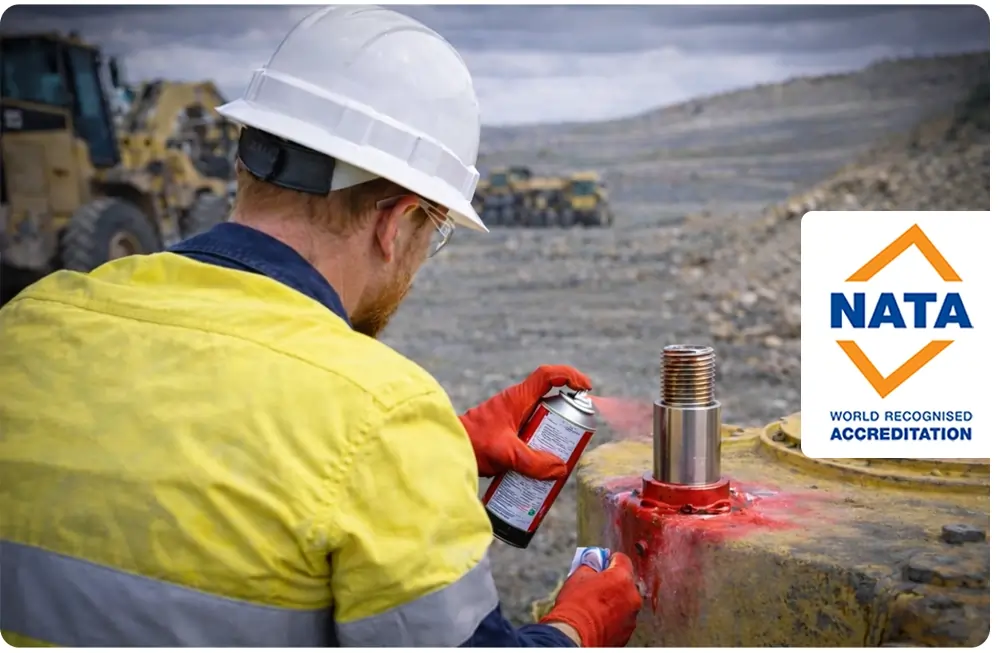
What is Liquid Penetrant Testing?
Liquid Penetrant Testing is a surface inspection method that uses capillary action to identify surface-breaking discontinuities. A specially formulated penetrant liquid is applied to the surface of a component, where it is drawn into any open defects such as cracks, porosity or laps. After a controlled dwell time, excess penetrant is removed and a developer is applied to draw penetrant back out of the defect, creating a visible indication.
Liquid penetrant testing is suitable for use on a wide range of non-porous materials, including ferrous and non-ferrous metals, and is particularly effective for inspecting complex geometries where other NDT methods may be limited.
Applications of Liquid Penetrant Testing
Liquid penetrant testing is commonly used during fabrication, maintenance and in-service inspections to identify surface defects. Typical applications include:
- Inspection of welds for surface-breaking cracks and porosity
- Examination of castings and forgings
- Detection of grinding cracks, laps and seams
- Inspection of stainless steel, aluminium and other non-magnetic materials
- Maintenance shutdown inspections
- Quality assurance and quality control during fabrication
Early identification of surface defects supports effective maintenance planning and reduces the risk of in-service failure.
Liquid Penetrant Testing Equipment and Materials
Liquid penetrant testing relies on controlled inspection materials and procedures to achieve reliable results. Key elements include:
- Penetrant liquids (visible dye or fluorescent)
- Cleaners and removers for surface preparation and excess penetrant removal
- Developers to enhance defect visibility
- Appropriate lighting conditions, including UV light for fluorescent inspections
- Clean, dry and non-porous inspection surfaces
Correct surface preparation, dwell times and viewing conditions are essential to achieving accurate and repeatable inspection outcomes.
AME Liquid Penetrant Testing Process
AME follows a structured and standards-based penetrant testing process to ensure consistent inspection quality:
Inspection requirements, acceptance criteria and applicable standards are reviewed prior to testing.
The inspection surface is cleaned to remove contaminants that may prevent penetrant entry.
Penetrant is applied evenly to the surface and allowed to dwell for a specified period.
Excess penetrant is carefully removed without extracting penetrant from surface defects.
Developer is applied to draw penetrant from defects and form visible indications.
The surface is examined under appropriate lighting conditions and indications are assessed against acceptance criteria.
Inspection findings are documented clearly and reviewed in line with project or client requirements.
Benefits of Liquid Penetrant Testing
- High sensitivity to surface-breaking defects
- Suitable for complex shapes and geometries
- Applicable to ferrous and non-ferrous materials
- Cost-effective and relatively quick inspection method
- Portable equipment suitable for field and workshop use
- Clear visual indications when performed correctly
Limitations of Liquid Penetrant Testing
While liquid penetrant testing is highly effective for surface inspection, certain limitations must be considered:
- Only detects surface-breaking defects
- Requires clean, non-porous surfaces
- Not suitable for rough, coated or absorbent materials
- Interpretation depends on inspection conditions and technician competence
AME ensures inspections are carried out by qualified personnel in accordance with approved procedures to manage these limitations effectively.
Australian Standards
All AME Liquid Penetrant Testing is carried out under our NATA-accredited quality system and in accordance with the following standards:
| Document Number | Reference Title / Scope |
|---|---|
| AS ISO/IEC 17025 | General requirements for the competence of testing and calibration laboratories |
| AS ISO 9712 | Non-destructive testing – Qualification and certification of personnel |
| AS ISO 3452.1 | Non-destructive testing – Penetrant testing – Part 1: General principles |
| AS ISO 3452.2 | Non-destructive testing – Penetrant testing – Part 2: Testing of penetrant materials |
| AS ISO 3452.3 | Non-destructive testing – Penetrant testing – Part 3: Reference test blocks |
| AS ISO 3452.4 | Non-destructive testing – Penetrant testing – Part 4: Equipment |
| ISO 3059 | Non-destructive testing – Penetrant testing and magnetic particle testing – Viewing conditions |
| ISO 23277 | Non-destructive testing of welds – Penetrant testing – Acceptance levels |
| ISO 17637 | Non-destructive testing of welds – Visual testing (supporting inspection requirements) |
| ASTM E1417 / E1417M | Standard Practice for Liquid Penetrant Testing |
| ASTM E165 / E165M | Standard Practice for Liquid Penetrant Examination |
| ASTM A275 / A275M | Standard Practice for Liquid Penetrant Examination of Steel Forgings |
| OEM Procedures | According to asset type, client requirements, and required NDT scope |
Why Choose AME?
AME provides trusted NDT services supported by engineering expertise and practical industry experience. Our liquid penetrant testing services offer:
- NATA-accredited inspection services
- Qualified and experienced NDT technicians
- Standards-compliant inspection procedures
- Clear, practical inspection reporting
- Experience across mining, industrial and infrastructure assets
- Integration with broader inspection, integrity and engineering services
Other NDT Services We Offer
In addition to liquid penetrant testing, AME offers a comprehensive range of NDT services, including:
Ultrasonic Testing (UT) is a widely used non-destructive testing method that applies high-frequency sound pulses to inspect materials from the inside, helping locate hidden defects, verify wall thickness, and identify subsurface flaws in structural components.
➜ Discover AME’s Ultrasonic Testing Services
Magnetic Particle Testing (MPT) is a non-destructive inspection method used to detect surface and near-surface defects in ferromagnetic materials. By applying a magnetic field and fine particles, MPT reveals cracks, laps, seams, and other discontinuities that may compromise structural integrity in components and welded structures.
➜ Learn more about AME’s Magnetic Particle Testing Services
Eddy Current Testing (ET) is a non-destructive inspection technique that relies on electromagnetic fields to detect surface and near-surface defects, measure coating thickness, and analyse material characteristics in non-ferrous components.
➜ Explore AME’s Eddy Current Testing Services
Often considered the starting point of non-destructive testing, visual inspection involves carefully assessing component surfaces with proper lighting, magnification, and imaging equipment to spot visible flaws and verify overall surface integrity.
This integrated approach allows inspection results to be incorporated into practical asset management solutions.
Book a Liquid Penetrant Testing Service
To discuss liquid penetrant testing requirements or arrange an inspection, contact AME today. Our team can assist with inspection planning, testing and reporting to support safe and reliable asset operation.
Contact AME Perth on (08) 9466 7444 or email info@asseteng.com.au or Kalgoorlie on (08) 9091 3553 or email to kalgoorlie@asseteng.com.au for further details.