


Ultrasonic Testing (UT) is one of the most widely used non-destructive testing (NDT) methods for assessing the internal condition of materials without causing damage.
At AME, we use UT to detect flaws, corrosion, and changes in material thickness with a high degree of precision. Our technicians provide reliable inspections across the mining, mining, energy, heavy industry, and infrastructure sectors.
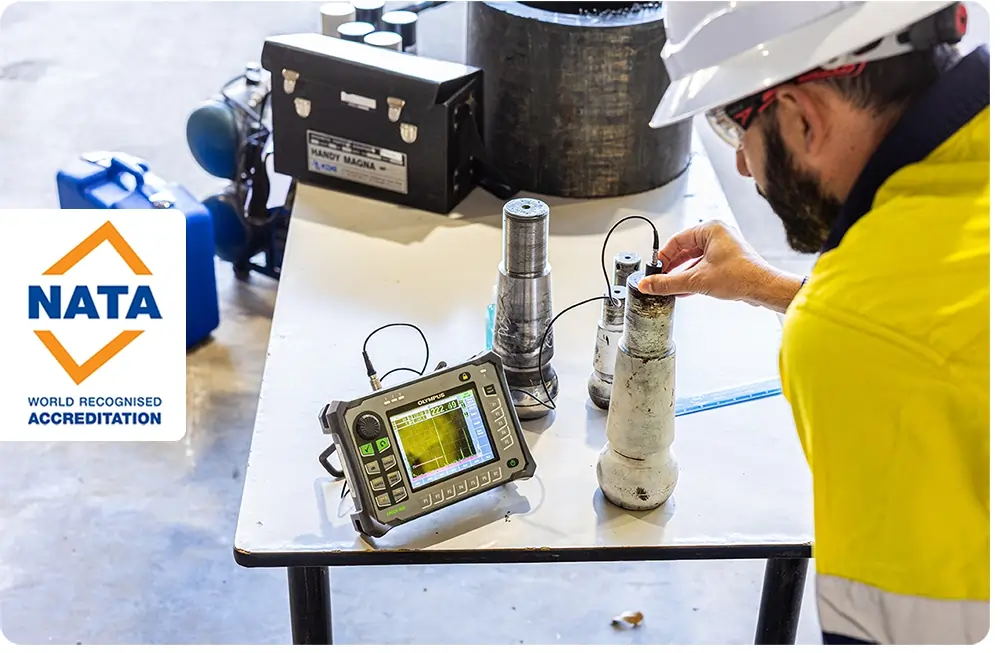
What is Ultrasonic Testing?
Ultrasonic Testing works by transmitting high-frequency sound waves into a material. When these waves encounter a change in density—such as a crack, void, or the back wall of the object—they are reflected back to the probe.
By measuring the time it takes for the signal to return, our technicians can determine material thickness, identify defects, and locate internal flaws. This process allows critical assets such as pressure vessels, pipework, tanks, and structural components to be inspected without the need for cutting or dismantling.
Applications
UT is suitable for almost any dense material and is used across a wide range of industries and applications, including:
- Corrosion and erosion monitoring in piping, vessels and tanks
- Wall thickness measurement for condition monitoring programs.
- Weld inspections to detect internal cracks or lack of fusion.
- Integrity testing of castings, forgings, and fabricated structures.
- Composite and aerospace component inspections.
By detecting issues early, ultrasonic testing helps extend the service life of assets and reduces the risk of unexpected failures.
Equipment and Setup
AME uses advanced digital flaw detectors and precision thickness gauges capable of identifying even the smallest defects.
A specialised couplant—typically a gel or liquid—is applied between the probe and test surface to ensure accurate transmission of sound waves. Proper surface preparation and calibration are key to producing consistent, verifiable results.
AME Ultrasonic Testing Process
At AME, our ultrasonic testing process follows a structured and consistent approach to ensure accuracy, repeatability, and compliance with relevant Standards and procedures. Each inspection is planned around the asset’s condition, accessibility, and service environment.
Our technicians begin by reviewing inspection specifications, asset drawings, and previous NDT reports to define the testing scope and acceptance criteria.
Before each job, we calibrate the ultrasonic instruments using standard reference blocks to ensure measurement accuracy and signal reliability.
The inspection area is cleaned to remove coatings or debris, and a suitable couplant is applied to ensure proper sound transmission.
Using either straight-beam or angled-beam probes, sound waves are introduced into the material. Any reflected or attenuated signals are recorded for analysis.
Signal responses are assessed to identify and characterise any discontinuities, such as cracks, inclusions, or corrosion thinning.
A detailed report is prepared outlining the test results, material thickness readings, defect locations, and recommendations for corrective action if required.
AME’s engineers review the results with the client to help plan maintenance strategies or repair priorities based on the findings.
Benefits of Ultrasonic Testing
- Detects surface and subsurface flaws with excellent accuracy.
- Requires access to only one side of the material.
- Provides immediate, on-site results for faster decision-making.
- Safe and non-hazardous for operators and surrounding equipment.
- Portable systems suitable for field and workshop applications.
- Capable of measuring depth, size, and orientation of defects.
Limitations
UT is highly effective but requires skilled interpretation. Rough or uneven surfaces can reduce accuracy, and proper calibration is essential for reliable data. AME technicians are trained and certified in accordance with Australian and International Standards to ensure accuracy and repeatability.
Australian Standards, International Standards and OEM Specific Procedures
All AME ultrasonic testing is carried out to the relevant Standards, including:
| Document Number | Reference Title |
|---|---|
| AS ISO/IEC 17025 | General requirements for the competence of testing and calibration laboratories |
| AS ISO 9712 | Non-destructive testing – Qualification and certification of personnel |
| AS ISO 20807 | Non-destructive testing – Qualification of personnel for limited application of non-destructive testing |
| AS ISO 16809 | Non-destructive testing – Ultrasonic thickness measurement |
| ISO 16811 | Non-destructive testing – Ultrasonic testing – Sensitivity and range setting |
| ISO 5577 | Non-destructive testing – Ultrasonic testing – Vocabulary |
| ISO 22232-1 | Characterization and verification of ultrasonic test equipment — Part 1: Instruments |
| ISO 22232-2 | Characterization and verification of ultrasonic test equipment — Part 2: Probes |
| AS 2083 | Calibration blocks and methods of use in ultrasonic testing |
| AS 1065 | Ultrasonic testing of carbon & low alloy steel forgings |
| AS 2207 | Ultrasonic testing of fusion welded joints in carbon and low alloy steel |
| ISO 18490 | Evaluation of vision acuity of NDT personnel |
| OEM Procedures | According to asset type and required NDT scope |
Compliance with these standards and procedures ensures that each inspection meets integrity and quality expectations.
Why Choose AME
- NATA accredited for ISO/IEC 17025.
- Qualified ISO 9712 Level II NDT technicians.
- Modern, calibrated ultrasonic testing equipment.
- Proven experience across mining, energy, heavy industry, and infrastructure.
- Detailed inspection reports with clear interpretation.
- Integration with other NDT and engineering services for complete asset integrity management.
Other NDT Services We Offer
Alongside ultrasonic testing, AME provides a range of complementary non-destructive testing (NDT) services to help clients assess the integrity and performance of critical assets.
Our NDT capabilities include:
Magnetic Particle Testing (MT) is used for detecting surface and slightly subsurface discontinuities in ferromagnetic materials such as steel. This method is particularly effective for welds, castings, and machined parts.
➜ Learn more about AME’s Magnetic Particle Testing Services
Dye Penetrant Testing (PT) is ideal for identifying surface-breaking cracks, porosity, and other defects in non-magnetic materials including stainless steel and aluminium.
Eddy Current Testing (ET) is a versatile electromagnetic technique used to detect surface and near-surface flaws, measure coating thickness, and verify conductivity in non-ferrous materials.
➜ Learn more about AME’s Eddy Current Testing Services
The most fundamental form of NDT, visual inspection involves detailed surface examinations using magnification, lighting, and digital imaging tools to detect visible flaws and verify surface conditions.
AME’s qualified technicians are trained to apply the most appropriate inspection method for each situation. Whether you need a single method or a combined testing program, we deliver accurate, standards-compliant results to support maintenance, certification, and asset life management.
Book an Ultrasonic Testing Service
If you need accurate, non-destructive ultrasonic testing for your equipment or infrastructure, AME can help.
Contact our team to arrange an inspection or request a quote. We’ll ensure your assets are assessed safely, efficiently, and in full compliance with Australian Standards and or OEM procedures.
Contact AME Perth on (08) 9466 7444 or email info@asseteng.com.au or Kalgoorlie on (08) 9091 3553 or email to kalgoorlie@asseteng.com.au for further details.